注册 /
注册 /








The “computing-power steward” of the HPC-AI fusion era: Sugon releases Gridview 7.0
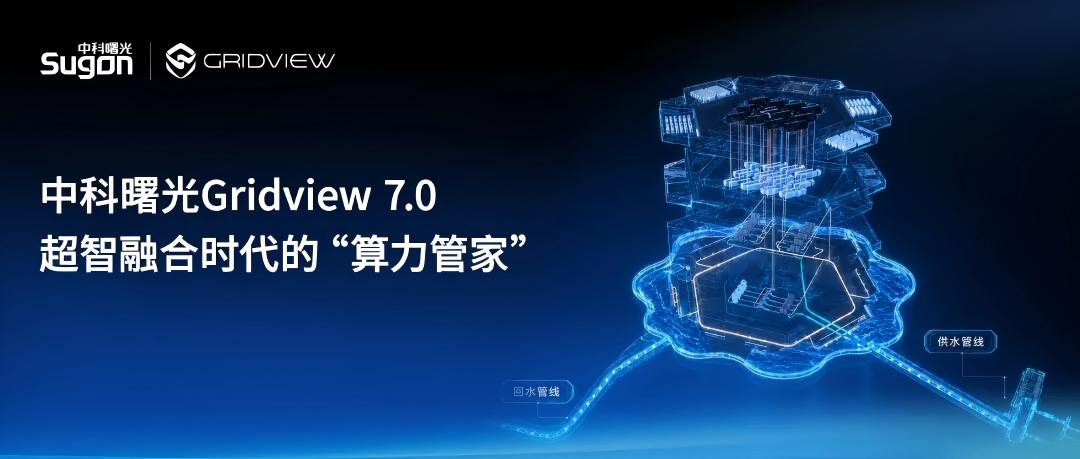
Recently, the Photosynthesis OrganizationDuring the 2026 Intelligent Computing Application Conference, Sugon officially released Gridview 7.0HPC-AI fusion platform,Experts and scholars from the Computer Network Information Center of the Chinese Academy of Sciences, national supercomputing centers, the University of Greater Bay Area, the National Astronomical Observatories of CAS, and other fields jointly witnessed the launch. The platform is designed for the HPC-AI fusion era,how connecting high-performance computing and artificial intelligence computing resourceshas become a key issue, Gridview 7.0Through efficient computing-power resource scheduling and management system, driving computing power from “construction” to “efficient use and scaled operations.”
▍HPC-AI fusion, solving large-scale computing-power scheduling challenges
As AI large models, scientific computing, and other applications are growing rapidly, and a single computing-power cluster is now carrying research simulation, model training, inference services, and other task types at once. How to unify management and elastically schedule computing-power resources of different architectures and business needs has become a new challenge for ultra-large computing-power infrastructure.
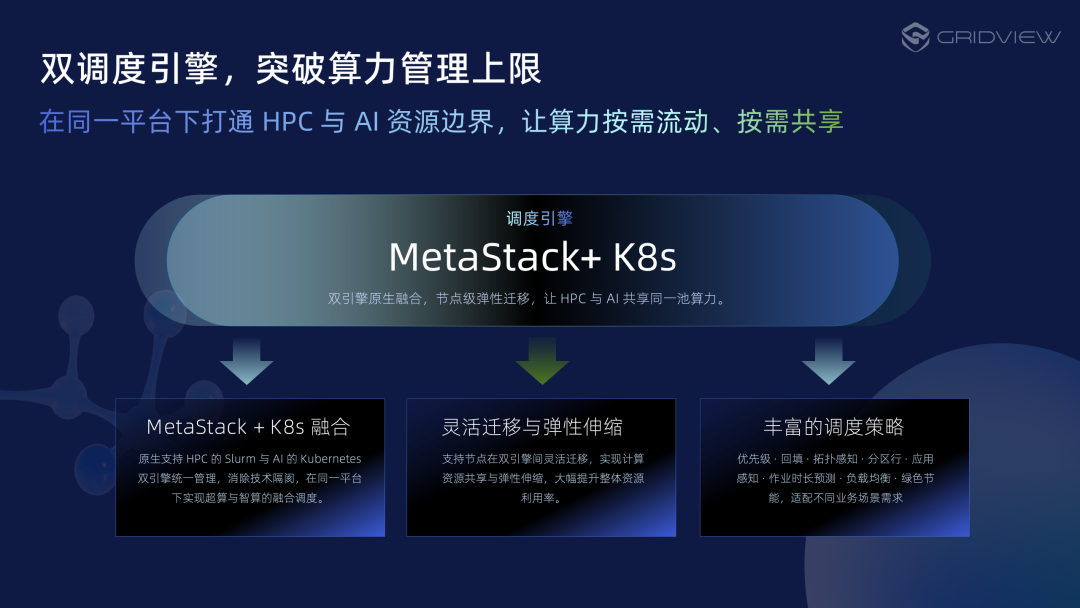
Through a dual-engine scheduling architecture, Gridview 7.0 achieves unified management and coordinated scheduling of supercomputer and intelligent computing resources. An architecture that fuses Sugon's in-house MetaStack scheduling engine with Kubernetes can flexibly allocate traditional scientific computing tasks and AI tasks in the same computing-power pool, improving resource utilization.
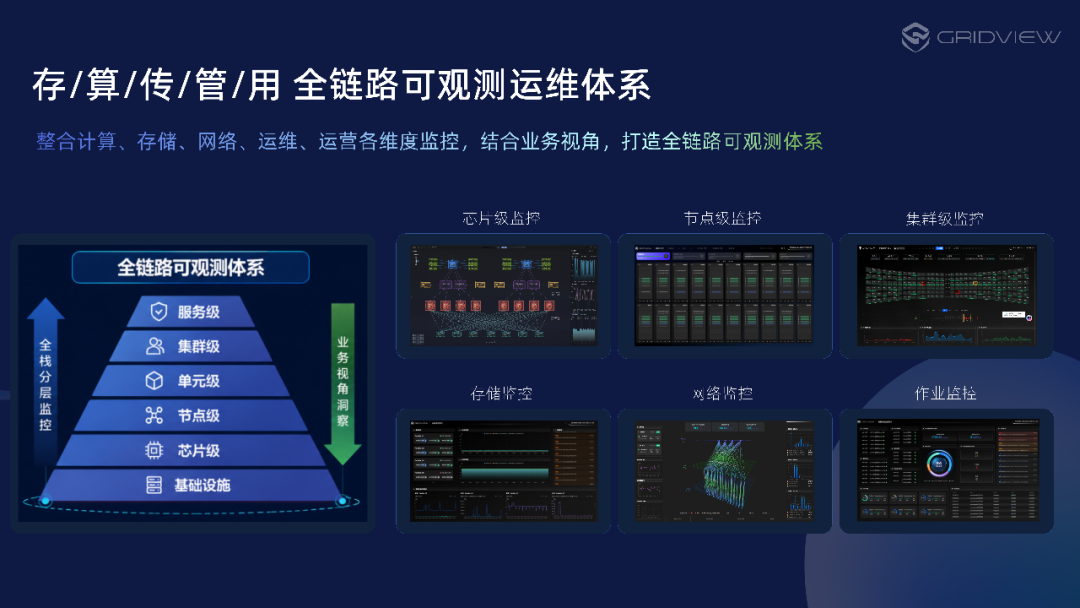
This capability is especially critical for ultra-large computing-power clusters.On July 18, during the 2026 World Artificial Intelligence Conference, China's first fully China-developed 100,000-card AI supercluster, named a “centerpiece exhibit” of the event—Sugon 8000 (Dengfeng) released the latest operating data. Demand surged in the cluster's first week online; average daily jobs now exceed 150,000, with a single-day peak above 500,000. Facing such-scale composite task-scheduling needs, Through unified resource management, intelligent scheduling policies, and full-chain monitoring, Gridview 7.0 supports stable operation of ultra-large computing-power clusters and enables efficient coordination of research computing, model training, inference services, and other tasks.
▍Dual-agent driven, moving toward “natural-language interaction + full-process automation”
Gridview 7.0 comprehensively strengthens AI capabilities and, through two core agents—the Materials Computing Agent and the Operations Agent—empowers research innovation and cluster operations respectively.
Materials Computing Agent:purpose-built for research users, supporting VASP, QuantumEspresso, Gaussian, and other mainstream quantum-chemistry and first-principles software, covering band-structure calculation, electron affinity, elastic modulus, and multiple research scenarios. Users can launch tasks directly in natural language (for example, “analyze the band structure of SiC”), the system automatically completes goal decomposition, software matching, input-file generation, result visualization, and report generation, substantially lowering the research barrier and raising computing efficiency.
Operations Agent:Users can issue operations instructions through natural-language dialogue (for example, “summarize major cluster faults,” “analyze why a job failed”), enabling zero-barrier operations. Based on multi-agent collaboration, it supports end-to-end automation from cluster-state retrieval, root-cause analysis, and log review to command-line execution, and combines an enterprise knowledge base with workflow templates to provide precise decision support for fault analysis and configuration checks.
In addition, Gridview 7.0 will continue to expand its industry-agent ecosystem, with dedicated agents for bioinformatics, industrial simulation, meteorology, geoscience, and more to be rolled out, covering RNA differential analysis, fluid-dynamics simulation, weather forecasting, assisted paper writing, and other industry computing scenarios.
▍From “managing computing power” to “operating computing power”
Gridview 7.0 has made the leap from a resource-management tool to a computing-power operations platform.users tiered management, machine-hour/card-hour/Token metering and billing models and a multidimensional data analytics dashboard, turning computing power into a measurable, priced, and settleable tradable commodity. For cross-region scheduling, unified multi-cluster portal authentication and global resource orchestration dynamically release idle computing power across sites, working in concert with SCNetThe Supercomputing Internet fuses online and offline resources, forming the prototype of a distributed computing-power network.
In addition, the platform further strengthens supernode adaptation, enabling automatic resource-topology discovery, rapid model deployment, and inference-service optimization to meet large-scale the needs of AI model training and inference scenarios.
▍Building an open computing-power service ecosystem
Today, computing-power infrastructure is moving from standalone build-out to networked coordination.Gridview 7.0 further strengthens multi-cluster resource coordination, supporting unified access and collaborative operations for computing-power resources of different regions and types, and linking with the National Supercomputing Internet platform to help dispersed computing-power resources circulate more efficiently.
To date, Gridview-series platforms have served more than 1500 users, managing accelerator cards at the 100,000-card scale. The release of Gridview 7.0 marks Sugon's further evolution in computing-power infrastructure from a resource-management platform to a computing-power operations service platform.
# Sugon News