SSE Stock Code:603019

Login
WeChat Login
Open WeChat and scan the QR code

Scan successful
Do not refresh this page. Follow the prompts on your phone

Sugon will never ask you to transfer money. Beware of fraud

Your WeChat is not registered
Sugon will never ask you to transfer money. Beware of fraud
You can also follow the Sugon WeChat official account
Scan with WeChat to log in. Access materials more easily.
You have registered an account and
followed the WeChat official account

January 2025
Please complete the security check
Service Hotline:400-810-0466
Live Support, Online Repair, Warranty Inquiry, Device Binding, Complaints

Background
When water conservancy thrives, the harvest is rich. China has 98,000 reservoirs, including 4,700 large and medium-sized ones. They play major roles in flood control, ice-jam prevention, storage, water supply, and power generation. Dams work together with reservoirs, hydropower plants, and other hydraulic hubs to stabilize urban development. Digital twins supply real-time sensing data for dam safety management and strong support for flood prediction and timely critical decisions. Digital-twin water conservancy is a new idea and model for smart water conservancy—a new technical path that will draw more industrial strength and intellectual resources into a basin-scale innovation platform.
Solution
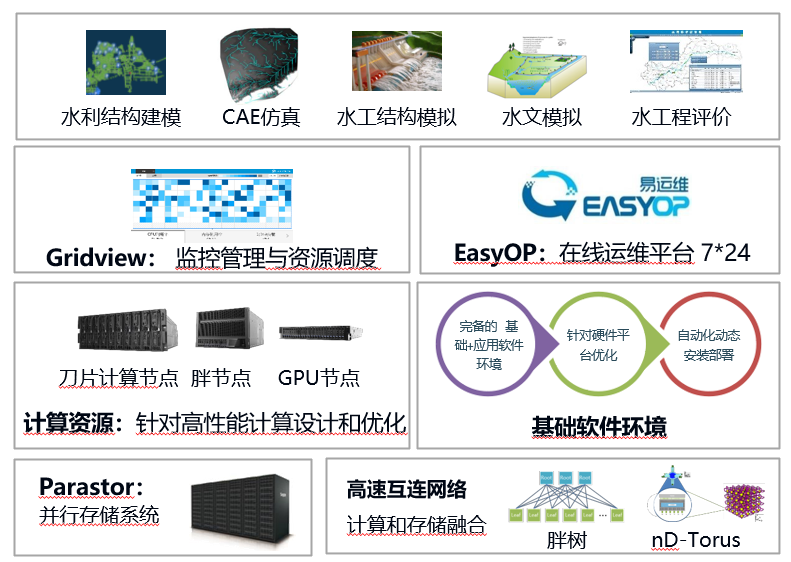
By fusing its own software with a Sugon computing platform, the China Institute of Water Resources and Hydropower Research (IWHR) successfully built a dam digital twin. On the Sugon platform, the dam is simulated in virtual space across time, space, materials, and cost to predict dam capacity in advance, contributing to safer development of China’s water sector.
Customer Benefits
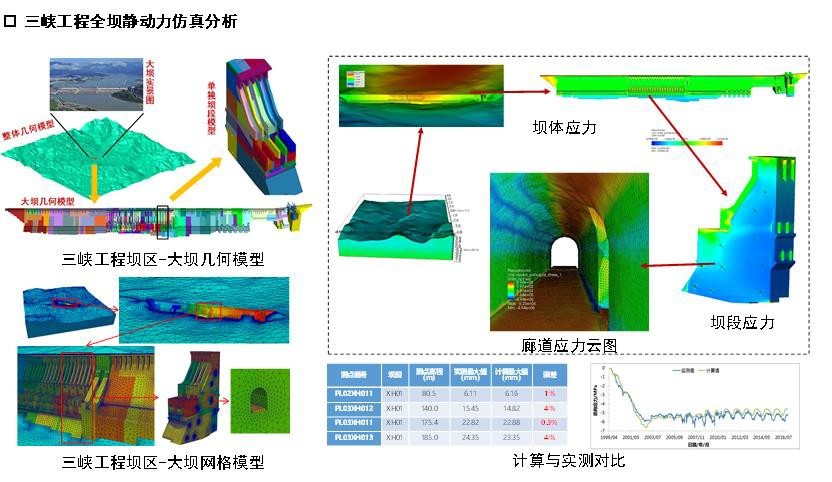
On the Sugon computing platform, users for the first time built a sub-meter-resolution fine finite-element model of the Three Gorges Project that fully reflects detailed structure and complex geological conditions; for the first time completed simulation analysis of the full dam’s temperature, deformation, and stress fields and dynamic analysis under extreme seismic load, achieving comprehensive performance assessment under normal operation and extreme earthquake conditions; and for the first time built a cross-scale finite-element model of an optomechanical-device foundation and target sphere, completed full-system simulation of the optomechanical device, and achieved high-precision assessment of vibration characteristics and stability.





 +86 400-810-0466
 international@sugon.com
 津公网安备 12011602000521号
+86 400-810-0466
international@sugon.com
津公网安备 12011602000521号
津公网安备 12011602000521号
+86 400-810-0466
international@sugon.com
津公网安备 12011602000521号


 Register /