SSE Stock Code:603019

You can also follow the Sugon WeChat official account
Scan with WeChat to log in. Access materials more easily.

January 2025
Service Hotline:400-810-0466
Live Support, Online Repair, Warranty Inquiry, Device Binding, Complaints

Background
In recent years, as China’s innovation capability and level have continued to rise, patent applications have kept growing rapidly. The volume of data submitted by applicants increases daily, and unstructured data account for more than 80% of the total, placing higher requirements on the performance and capacity of unstructured-data storage in the electronic-examination system.
The CNIPA patent E-system upgrade and expansion aims to meet unstructured-data storage needs of internal and external network business systems over the next three years.
This upgrade of the distributed storage system mainly provides unstructured-data storage for China’s patent electronic-examination system, design examination, and new intelligent examination. The system is used by 14 business departments and units, covering 29 agency offices outside the bureau, with about 8,000 users.
Business Requirements
To optimize read/write efficiency of unstructured data in the examination workflow, Sugon provided a distributed parallel storage solution optimized for small-file read/write to replace the original NAS storage. Based on the E-system’s existing data volume, user-access performance requirements, and high growth over the next three years, the customer chose the Sugon ParaStor distributed storage solution. ParaStor’s advanced architecture gives it strong scale-out capability: simply adding data controllers yields greater capacity and more data channels, and thus higher aggregate bandwidth and I/O performance. As data controllers are added, capacity and bandwidth grow nearly linearly, meeting concurrent access from thousands of clients.
Distributed storage architecture design:
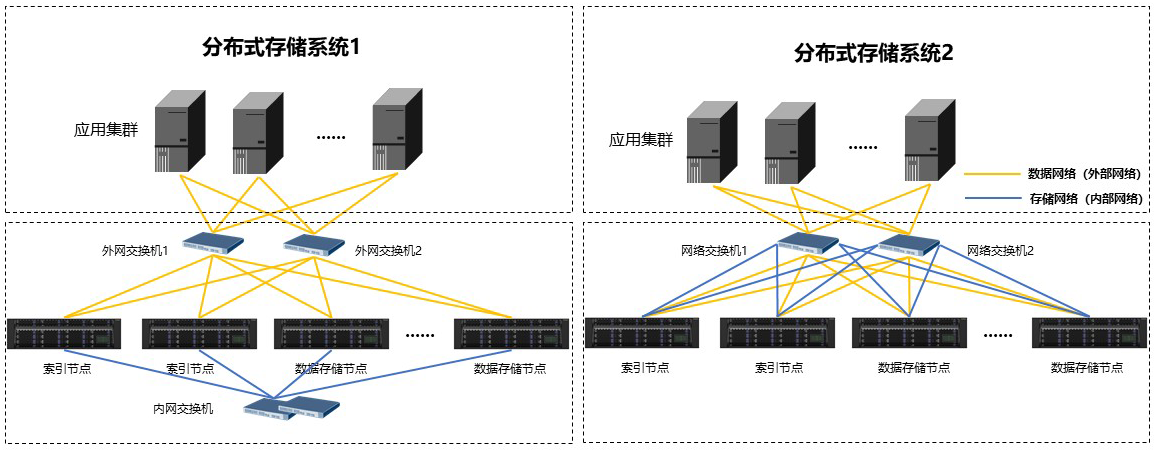
This storage upgrade optimizes storage, read/write processes, and methods for the patent office’s existing unstructured data, realizing fast read/write, secure storage, and high-concurrency access, raising examination-business efficiency for unstructured data and reducing wait time.
Design Features
1. High-concurrency I/O, high-speed link aggregate bandwidth
Sugon ParaStor aggregate performance increases as data-storage nodes are added. Aggregate bandwidth can be calculated as per-node bandwidth multiplied by node count, and system performance can grow linearly. Sugon ParaStor distributed storage can provide aggregate bandwidth of up to 100 GB/s.
2. A single namespace supporting hundreds of billions of files
A single directory in Sugon ParaStor can efficiently hold tens of millions of files or subdirectories. Because storage nodes can scale dynamically, the whole file system can easily reach hundreds of billions of files. All storage nodes serve externally at the same time, supporting high-speed queries of massive files and easily handling concurrent, intensive read/write from large numbers of clients.
3. Fully redundant architecture, erasure coding, and other data-protection mechanisms, with no single point of failure
Sugon ParaStor uses a fully redundant architecture, erasure coding, efficient data reconstruction, and automatic fault recovery. Reliability and data security are very high; 1 TB can be repaired in only half an hour.
4. Storage-node fault tolerance
Sugon ParaStor protects data with N+M erasure coding. N+M can provide up to N+4 protection, so any 4 disks or any 4 storage nodes can fail simultaneously without affecting data safety.
5. Automatic fault recovery
ParaStor has a built-in automatic fault-detection mechanism. Once a fault is detected, the data-recovery process starts automatically.
Customer Benefits
1. Built an unstructured-data storage platform that meets unstructured-file storage requirements;
2. Realized online, real-time expansion of the unstructured-data storage platform to any size;
3. Realized fast read/write of massive small files, reducing wait time and raising system efficiency;
4. Met high-bandwidth requirements for unstructured-data read/write under large-user concurrency.





 +86 400-810-0466
 international@sugon.com
 津公网安备 12011602000521号
+86 400-810-0466
international@sugon.com
津公网安备 12011602000521号
津公网安备 12011602000521号
+86 400-810-0466
international@sugon.com
津公网安备 12011602000521号


 Register /