SSE Stock Code:603019

You can also follow the Sugon WeChat official account
Scan with WeChat to log in. Access materials more easily.

January 2025
Service Hotline:400-810-0466
Live Support, Online Repair, Warranty Inquiry, Device Binding, Complaints

Songshan Lake Materials Laboratory was established in 2018 jointly by the Dongguan Municipal Government, the Institute of Physics of the Chinese Academy of Sciences, and the Institute of High Energy Physics of the Chinese Academy of Sciences. Looking ahead, the laboratory will deploy a major facility for materials preparation and processing in extreme environments (working name), three core pillars of frontier basic research, a public technology platform and an innovation demonstration factory, plus a Guangdong–Hong Kong–Macao Interdisciplinary Science Center and a technology-transfer center. The Institute of Physics, Chinese Academy of Sciences, is the lead unit. The laboratory operates under a director-responsibility system under the Board of Directors and is a Dongguan municipal public institution. Academician 王恩哥 serves as Chairman of the Board, Academician 汪卫华 as Laboratory Director, and Academician 赵忠贤 as Chair of the Academic Committee. The overall plan covers 1,200 mu, with total investment of about RMB 12 billion. After completion, staffing will be about 6,600, including 2,200 permanent staff, 2,200 graduate students, and about 2,200 mobile personnel such as postdoctoral researchers. Songshan Lake Materials Laboratory is positioned to become an internationally influential southern base for new-materials R&D, an important part of China’s future national materials science, a new window of Guangdong–Hong Kong–Macao interdisciplinary openness, and a Guangdong–Hong Kong–Macao research center with an international brand.
Customer Requirements
In recent years, computational simulation has become an important means of materials research and design. The powerful computing performance of high-performance computing systems can greatly accelerate materials simulation and raise the efficiency of materials design. High-throughput computing on HPC, building materials big data and forming a materials genome have become mainstream methods in materials science. Songshan Lake Laboratory urgently needs an HPC system to meet the computing demand of materials research.
In computing resources, high-throughput computing needs strong performance to raise efficiency, as well as a cluster management system for unified resource management, real-time scheduling of high-throughput jobs, and higher resource utilization.
In storage, high-throughput computing produces massive volumes of computational data that will form materials-genome data. The storage system must therefore offer not only large capacity but also excellent read/write performance, plus good scalability so that it can expand smoothly to meet future data needs.
Solution Design
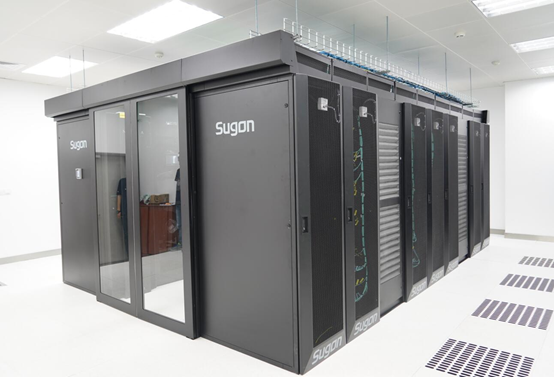
Sugon built an HPC cluster named “TianGong” for Songshan Lake Materials Laboratory. TianGong is configured with the mature, stable TC4600E blade computing platform, delivering strong computing performance. In addition to the blade platform, and to match the computing characteristics of materials applications, TianGong also includes multi-core compute nodes, fat nodes and GPU heterogeneous compute nodes. This mix of equipment provides ample compute for materials simulation and also supports materials data mining, deep learning and the construction of materials databases. The TianGong HPC cluster uses Sugon pool-level micro-modules to meet power and cooling needs.
In materials research, computational data is the most valuable asset. Sugon configured the ParaStor parallel storage system for TianGong. ParaStor uses erasure coding and other technologies to protect data, while supporting parallel access from compute nodes for excellent read/write performance. ParaStor supports scale-out expansion, with aggregate read/write bandwidth growing linearly with capacity, fully meeting the laboratory’s future computing needs.
Sugon provided a complete software runtime for the TianGong HPC cluster. For common materials-computing applications (such as VASP and Quantum ESPRESSO), math libraries and MPI parallel libraries were optimized for the best runtime results. TianGong uses the Gridview cluster management system to manage all resources in a unified way, monitor node status in real time, and support real-time scheduling of high-throughput jobs, maximizing use of cluster computing resources.
Customer Value
The TianGong HPC cluster for the materials-computing and database platform is an important technical support platform for Songshan Lake Materials Laboratory. It underpins HPC, scientific-computing software development, materials big data, and computation- and data-driven materials R&D. The platform is currently using TianGong and first-principles materials methods to build a materials database that will support China’s future materials R&D. A materials database is a knowledge base of materials. Future materials science will use materials big data to search for and predict new materials quickly, achieving more, faster, better and more economical results.





 +86 400-810-0466
 international@sugon.com
 津公网安备 12011602000521号
+86 400-810-0466
international@sugon.com
津公网安备 12011602000521号
津公网安备 12011602000521号
+86 400-810-0466
international@sugon.com
津公网安备 12011602000521号


 Register /