SSE Stock Code:603019

You can also follow the Sugon WeChat official account
Scan with WeChat to log in. Access materials more easily.

January 2025
Service Hotline:400-810-0466
Live Support, Online Repair, Warranty Inquiry, Device Binding, Complaints

Release Time: 2026-08-10
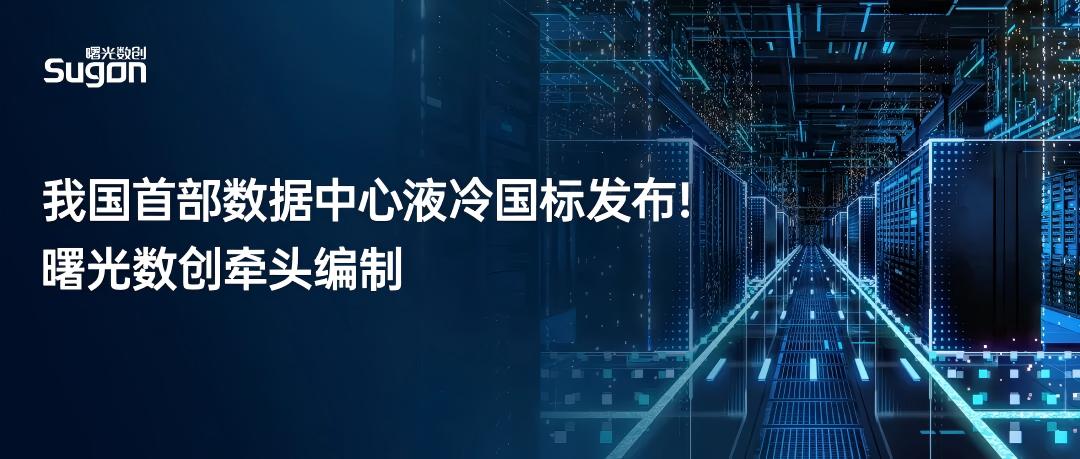
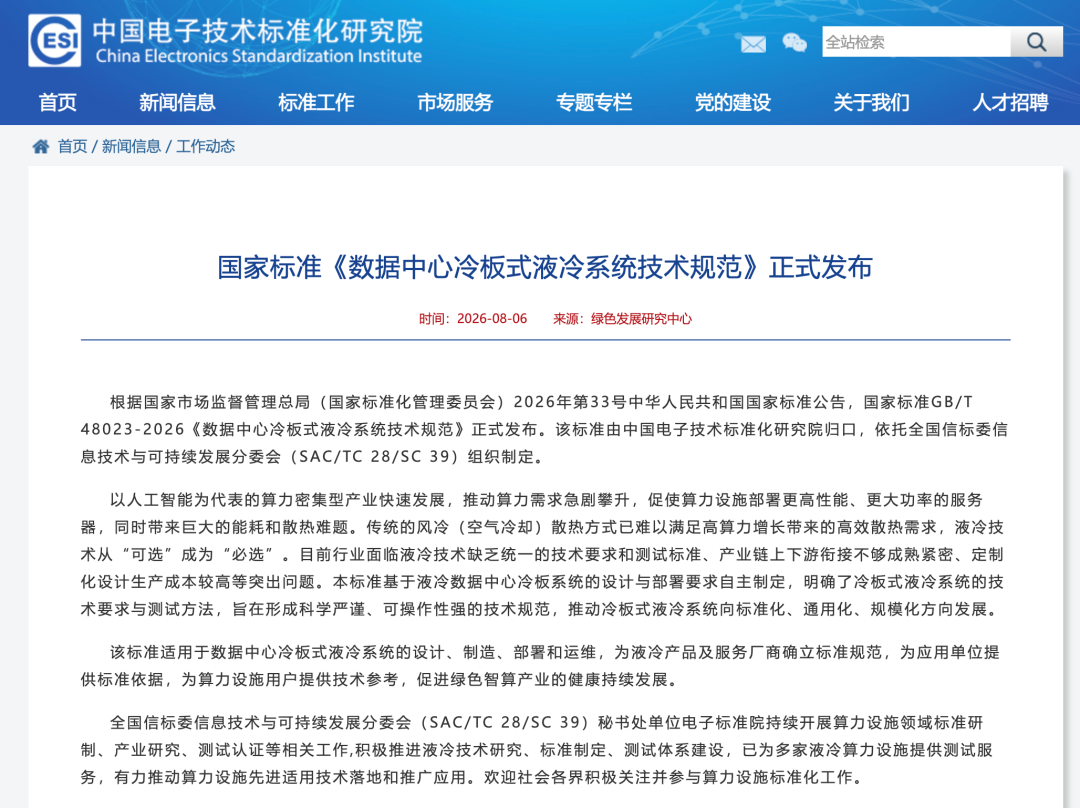
Recently, according to an announcement of the State Administration for Market Regulation (Standardization Administration of China), led by Sugon subsidiary Sugon DataEnergyled compilation of China's first national standard for data-center liquid cooling—GB/T 48023-2026 Technical Specification for Cold-Plate Liquid Cooling Systems in Data Centers (hereinafter the “Specification”)—which has been officially approved and released, and will take effect on February 1, 2027.This marks China's data-center liquid cooling industry officially entering a new stage of high-quality development with unified standards, ecosystem collaboration, and faster innovation.
In recent years, global AI computing-power demand has grown exponentially. Power density per cabinet in intelligent computing centers has climbed rapidly from 80kW to above 1MW, and liquid cooling has shifted from “optional” to “essential.” Yet relative to surging market demand, the liquid cooling industry has long lacked unified technical requirements and test standards. Upstream-downstream connections have not been mature or tight, and customized design and production costs have stayed high. Vendors have followed different technical routes and specifications, leaving interfaces incompatible and product quality uneven.
Against this backdrop, in July 2024, the national standard Technical Specification for Cold-Plate Liquid Cooling Systems in Data Centers was approved for project initiation by the Standardization Administration of China, It is under the centralized administration of the China Electronics Standardization Institute, with Sugon DataEnergy as chief compiling unit. After two years of development and successive reviews, the standard was officially released in July 2026.
For the first time, it systematically specifies technical requirements and test methods for cold-plate liquid cooling systems and key components, covering the full process of system design, component requirements, hydraulic calculation, test validation, and deployment operations, and providing the industry with a unified baseline framework.
As chief compiling unit, Sugon DataEnergy is not a latecomer riding this liquid cooling wave, but the earliest pathfinder. Years of deep technical work and large-scale commercial practice in liquid cooling supplied the core strength for drafting the standard.
In 2011, Sugon DataEnergy was first to propose a liquid cooling technology path and launch related research, gradually forming a full-stack layout covering both cold-plate and immersion routes. At the time, liquid cooling had yet to win mainstream industry acceptance. Over the following decade-plus, Sugon DataEnergy successively introduced C7000 cold-plate liquid cooling, C7000 2.0 air-liquid hybrid cooling, C7000-F phase-change indirect liquid cooling, C8000 immersion phase-change liquid cooling, and other products, It has built coverage from tens-of-kW medium-density cabinets to approaching 1MW ultra-high-density cabinets in a full-stack liquid cooling technology system, It can provide solutions in which “technology matches the scenario,” rather than “the scenario yielding to the technology,” for different computing-power scenarios.
While industrializing the technology, Sugon DataEnergy has shared its frontier exploration and large-scale deployment experience with the industry and forged consensus, growing from a technology explorer into a co-author of industrial rules. To date, Sugon DataEnergy has led or participated in drafting 5 national standards, 3 local standards, 7 industry standards, and more than 20 association standards, and is using the Specification as a fulcrum to advance standardization across the liquid cooling industry.
The birth of a national standard is never only a deposit of technical metrics; it is also a measure of industrial discourse power. For a long time, China's liquid cooling market sat in isolated “go-it-alone” silos, and the high cost of industry-chain coordination became the “Achilles' heel.
Zhang Peng, Senior Vice President of Sugon DataEnergy, noted: “Standards should not be technical barriers, but a ‘common language’ for efficient upstream-downstream collaboration.” By unifying cold-plate components, quick couplings, CDUand other core components' technical specifications and test methods, the Specification fully opens the industry chain's vital pathways, allowing different vendors to connect efficiently under one set of rules, cutting unnecessary cost from customization at the source and accelerating scaled replication of liquid cooling solutions.
As the global race in computing-power infrastructure enters deeper waters, standards themselves are becoming a key competitive factor beyond products. Implementation of the Specification will not only provide technical support for domestic regulators and a baseline for energy-efficiency evaluation, but also guide more users to trust and adopt liquid cooling, pushing China's liquid cooling from “customized projects” to “standardized products,” and thereby securing core discourse power in setting industrial rules.
In recent years, Sugon DataEnergy's full-stack liquid cooling technology system has appeared frequently on international stages including ISC in Hamburg, Germany; DCW in Singapore; and DCA in Hong Kong.China's liquid cooling industry has established a unified, efficient, and standardized ecological foundation at home, while also enters a new stage of systematic global layout.
From sowing the first liquid cooling seed in 2011 to presiding over the birth of the first liquid cooling national standard in 2026, every step Sugon DataEnergy has taken over fifteen years has made the “green heart” of China's computing power beat more scientifically, healthily, and strongly.#Sugon





 +86 400-810-0466
 international@sugon.com
 津公网安备 12011602000521号
+86 400-810-0466
international@sugon.com
津公网安备 12011602000521号
津公网安备 12011602000521号
+86 400-810-0466
international@sugon.com
津公网安备 12011602000521号


 Register /