SSE Stock Code:603019

You can also follow the Sugon WeChat official account
Scan with WeChat to log in. Access materials more easily.

January 2025
Service Hotline:400-810-0466
Live Support, Online Repair, Warranty Inquiry, Device Binding, Complaints

Analytics for national, provincial, and city clinical quality-control centers.




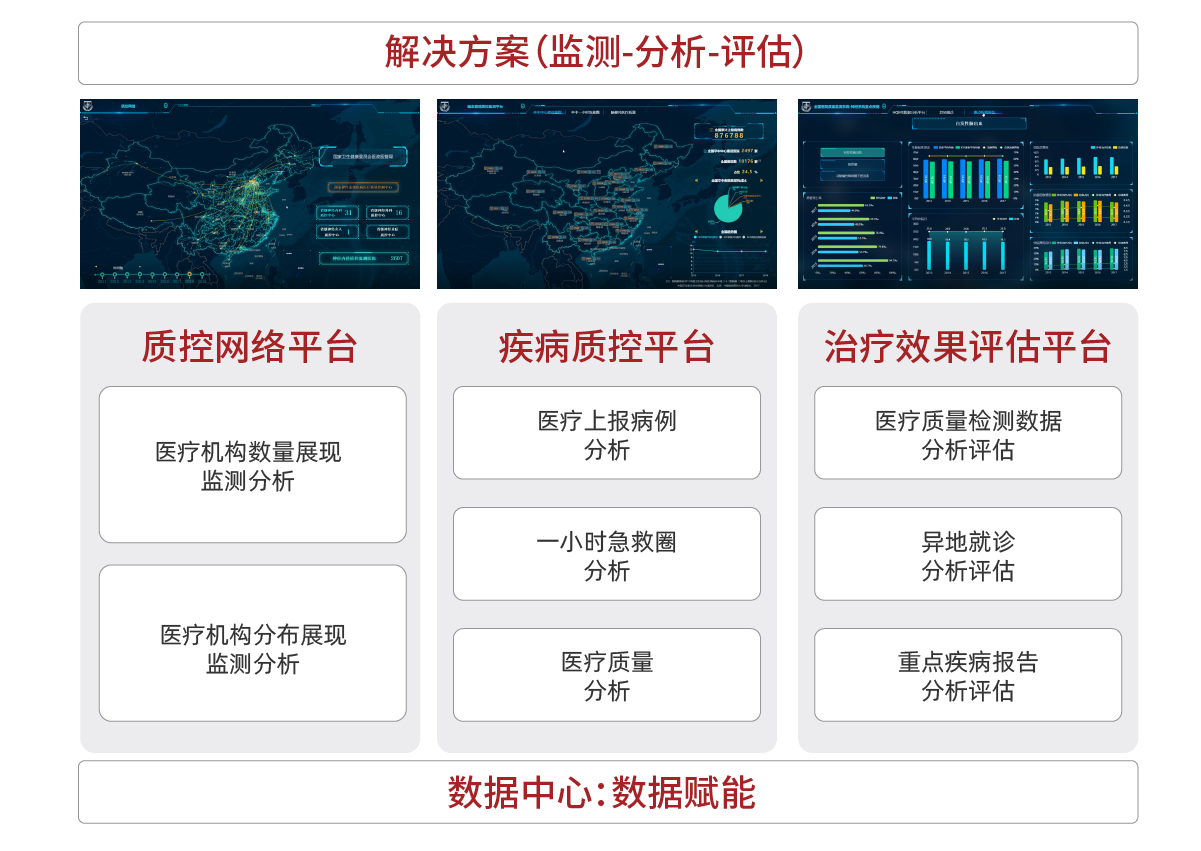
The smart medical quality-control center mainly realizes a 131N overall architecture, i.e., 1 monitoring center, 3 core platforms, 1 data center, and N unit accesses.
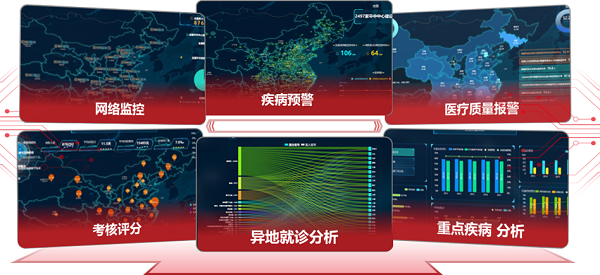
“1” monitoring center. Visual real-time monitoring of quality-control networks, diseases, medical treatment, key diseases, and other status.
“3” core platforms, mainly including a quality-control network platform, a disease quality-control platform, and a treatment-outcome evaluation platform.
The quality-control network platform realizes five major functions.
1) Hierarchical-relationship presentation. Medical units that join the alliance can be presented in detail by hierarchical relationships of national centers, provincial centers, municipal, and other medical institutions, showing network relationships at each layer.
2) Hospital basic-information presentation, showing counts and distribution of medical institutions in each province (city) on a map.
3) Present each hospital’s important indicators, such as reported case counts, disease types, and treatment-process indicators.
4) Hospital-status warning: automatically warn when hospital reported-data changes exceed thresholds.
5) Site-selection assessment, providing reference for new-hospital site selection.
The disease-analysis platform realizes three major functions.
1) One-hour emergency circle. Calculate each medical institution’s one-hour emergency-circle range in different time periods based on hospital medical capability, medical resources, surrounding population, traffic conditions, and other factors.
2) Disease KPI indicators. Key disease-treatment indicators such as mortality, composite indicators, and national averages of other key indicators used to calculate composites, plus corresponding provincial and city averages; perform pattern analysis and trend prediction based on KPI indicators.
3) Key-disease analysis. Analyze important indicators of important systemic diseases and intuitively present medical-quality information of various diseases.
The treatment-outcome evaluation platform realizes three major functions.
1) Disease treatment-outcome indicator analysis. Based on hospital-reported data, present various treatment-outcome indicators by disease, hospital, and other dimensions, and generate each hospital’s quality report from various indicators.
2) Cross-region visit-outcome analysis. Analyze inflow and outflow counts of key diseases by province (city), use this as a basis to judge medical level of various diseases in different provinces (cities), and use GIS maps and Sankey diagrams to present distribution patterns of patients’ cross-region visits from different visual angles.
3) Key-disease outcome analysis. Analyze quality-report data of key diseases and intuitively present various core indicator values in visual reports.
“1” data center, realizing comprehensive data governance, data integration, data synthesis, intelligent data analysis, and other functions.
“N” unit accesses. Based on the XData platform, access data from “N” medical institutions.
Enable full-volume data mining and real-time stream processing to discover patterns, monitor quality in real time, warn early, and design visual themes that show data value for QC-network (hospital-level), disease, and treatment-outcome analysis.
Monitor quality-control networks at all levels, watch disease conditions, and warn on anomalies.
Around disease medical quality-control goals, build industry data standards, unify medical QC data specifications, and govern data through cleaning, conversion, replacement, deletion, completion, and packaging.
Collect disease-related data from medical units at all levels into a basic data storage platform that meets efficient storage, analysis, and access needs for medical quality-control data.





 +86 400-810-0466
 international@sugon.com
 津公网安备 12011602000521号
+86 400-810-0466
international@sugon.com
津公网安备 12011602000521号
津公网安备 12011602000521号
+86 400-810-0466
international@sugon.com
津公网安备 12011602000521号


 Register /