SSE Stock Code:603019

You can also follow the Sugon WeChat official account
Scan with WeChat to log in. Access materials more easily.

January 2025
Service Hotline:400-810-0466
Live Support, Online Repair, Warranty Inquiry, Device Binding, Complaints

Cloud storage for telecom operators, based on years of Sugon storage products and projects.

Dynamically expand internal constituent units of the cloud storage system on demand, adopting the latest technology without changing system architecture

A unified namespace under the same file system, meeting telecom-industry requirements for unified management of large-scale storage resource pools

Increase storage capacity without adding administrators; provide better performance and EB-class storage, with storage bandwidth of tens or even hundreds of GB/s

Through the distributed file system’s load-balancing policy, spread data access across storage data nodes
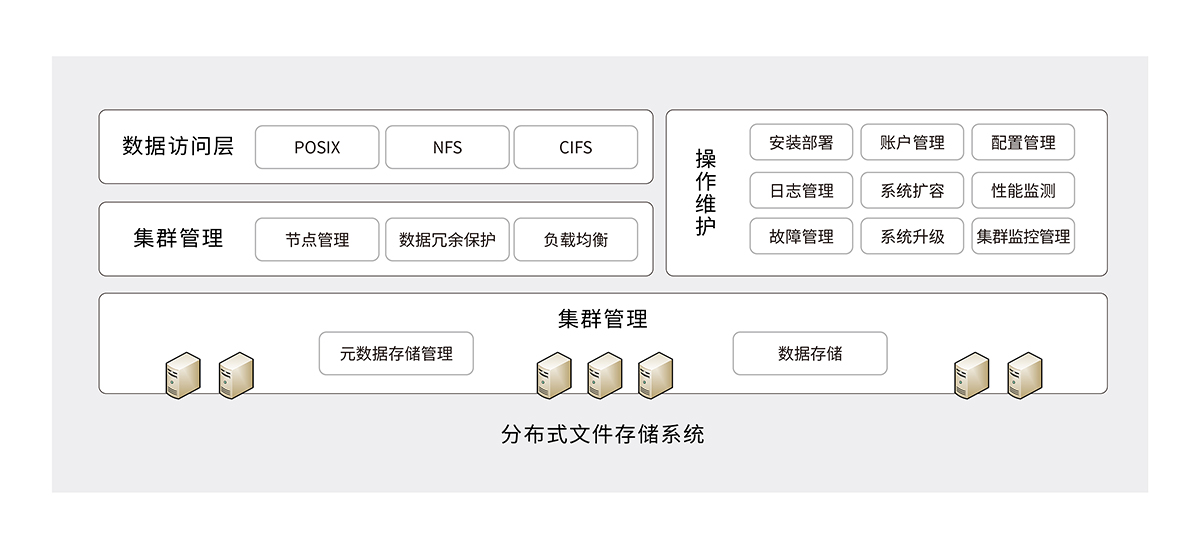
On the network, the distributed file system connects to application systems and the management system. Through standard interfaces NFS, CIFS, and POSIX, the distributed file system provides multi-user shared data-access services. The connection to the management system is mainly for the management system to manage the distributed file system, such as apply, provision, and change storage services, and report configuration, performance, and fault-management information.
The distributed file system functional architecture mainly includes four parts: data-access layer, data-storage management, cluster management, and operations and maintenance. The system is built on PC servers and manages on-disk data through OS APIs. Functions of each part:
Data access: integrated on the business-application side, providing APIs to operate data and handling request distribution and routing.
Cluster management: responsible for cluster construction, including node management and data sharding, undertaking data-redundancy protection and load balancing.
Data-storage management: undertakes in-node data management, including metadata management and large-capacity space management for data storage.
Operations and maintenance: provides install/deploy, user-account management, log management, performance monitoring, configuration management, fault management, and more, making it convenient for system administrators to operate and control the distributed file system.
Ensure that mechanical faults or partial data loss do not affect normal business, with automatic fault recovery.
Built with standard rack servers and an easy-to-use management UI.
Support PB-class massive storage space to meet users’ large-capacity needs.
Provide complete isolation for VMs that share resources.
Effectively use I/O resources while minimizing response time.
Expand easily to adapt to long-term business growth over many years.





 +86 400-810-0466
 international@sugon.com
 津公网安备 12011602000521号
+86 400-810-0466
international@sugon.com
津公网安备 12011602000521号
津公网安备 12011602000521号
+86 400-810-0466
international@sugon.com
津公网安备 12011602000521号


 Register /