SSE Stock Code:603019

You can also follow the Sugon WeChat official account
Scan with WeChat to log in. Access materials more easily.

January 2025
Service Hotline:400-810-0466
Live Support, Online Repair, Warranty Inquiry, Device Binding, Complaints

Uses liquid cooling instead of traditional air cooling to cut PUE in financial data centers.

Support decoupling of IT infrastructure from liquid-cooling infrastructure, fitting phased project construction. We can provide integrated delivery of servers + liquid-cooling infrastructure, with matched coupling and high-quality, efficient deployment.

Redundant heat-exchange units, real-time high-sensitivity liquid monitoring and load-balance adjustment; automatic warning reporting; self-sealing drip-free interfaces supporting tool-free hot swap

Sugon was first to launch industry liquid-cooling solutions and has rich experience deploying large-scale liquid-cooled clusters. Our liquid-cooled blade and rack servers are already in production-scale use in major state-owned bank data centers
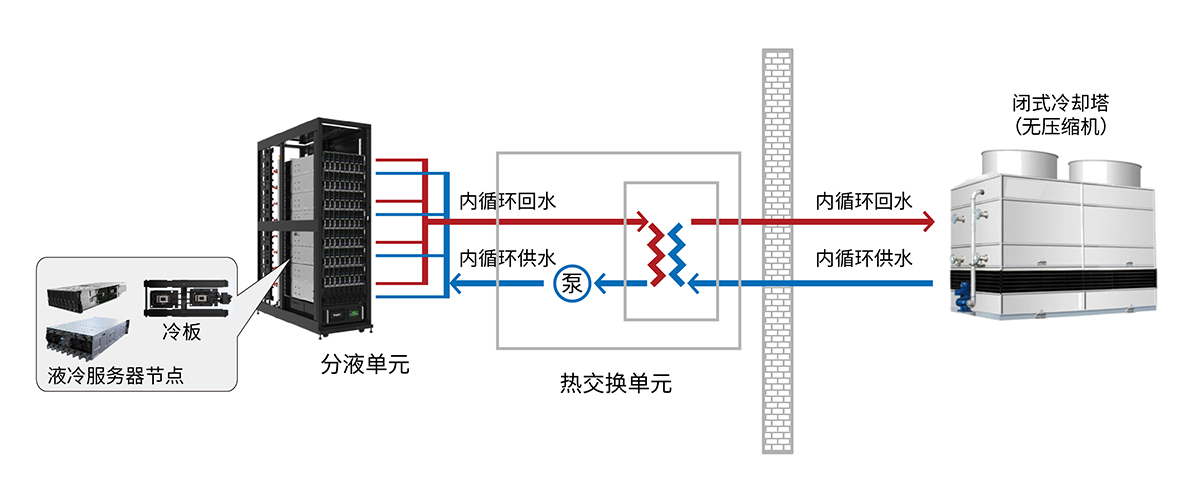
Liquid-cooled servers:CPU compute nodes use cold-plate liquid-cooled servers—TC4600E LP; the overall solution is an air-liquid hybrid cooling scheme. A cavity with flowing liquid is pressed against the heat source; heat conduction indirectly carries away most heat via flowing coolant. Liquid cooling is highly efficient, can lower PUE below 1.2, raise per-rack installed power to 30 kW, and substantially lower noise below 60 dB.
Manifold units:Vertical manifolds installed on both rear sides of the cabinet evenly distribute fluid to the horizontal manifolds of each liquid-cooled server. Horizontal manifolds exchange heat with the main in-server heat sources—CPU and memory.
Heat-exchange units:The heat-exchange unit (CDU) exchanges and distributes outdoor-side cooling water with indoor-side dedicated liquid-cooling coolant. The indoor side of the plate heat exchanger continuously supplies cold fluid, after exchanging with outdoor cooling water, to liquid-cooling cold plates; the outdoor side sends warmed cooling water to a closed cooling tower for exchange with the outside.
Cooling towers:A closed cooling tower places a tubular heat exchanger in the tower; circulating air, spray water outside the tubes, and circulating water inside the tubes exchange heat to cool. Closed circulation keeps liquid uncontaminated, well protecting efficient operation of main equipment and raising service life.
Lower CPU core temperature to 40–50°C, raising CPU performance by 5%; even heat dissipation eliminates hot spots, extends component life, and raises overall system stability.
Free cooling cuts air-conditioning energy by 70%; fan power falls 70%–80%; liquid-cooling PUE < 1.1; air-liquid hybrid PUE < 1.2.
Improved cooling efficiency can raise per-rack power density up to 2× versus air cooling, supporting up to 30 kW/rack and increasing overall data-center installed capacity.






 +86 400-810-0466
 international@sugon.com
 津公网安备 12011602000521号
+86 400-810-0466
international@sugon.com
津公网安备 12011602000521号
津公网安备 12011602000521号
+86 400-810-0466
international@sugon.com
津公网安备 12011602000521号


 Register /